


AI logo design is everywhere right now, and after 6 years of building brands, I get why. It’s fast, cheap, and feels like a shortcut to “done.” But here’s the issue most businesses only realize later: a logo isn’t a file, it’s a signal. When that signal is generic, your brand quietly blends into the noise.
75% of consumers recognize a brand by its logo, showing how crucial visual identity is to brand perception and recall.
After reviewing hundreds of AI-generated logos for startups and small businesses, the pattern is consistent: similar shapes, recycled typography, and zero strategic intent. That’s not branding, that’s decoration.
The solution isn’t avoiding AI altogether. It’s knowing when AI helps and when it hurts, and where professional logo design services add real leverage.
Businesses with distinctive brand identities are 3–4× more likely to achieve strong brand recognition, while low-cost, template-driven logos show significantly lower recall and trust.
Let’s discuss
Is AI Logo Design Good for Small Businesses?
Yes, but only in very specific situations. AI logo design can help small businesses move fast at the idea stage, but it becomes a liability the moment branding, trust, or growth enters the picture.
10–20% of marketing budgets are spent on branding and rebranding, meaning companies do invest in identity beyond initial DIY.
After working with startups and small businesses for over a decade, I’ve seen this play out repeatedly. AI logo tools aren’t inherently bad. They’re just often used at the wrong moment, for the wrong reasons, with unrealistic expectations.
For early-stage founders juggling budgets, speed feels like survival. AI logo generators promise a logo in minutes for a fraction of the cost, which makes them attractive.
But branding isn’t about getting a logo. It’s about building recognition, credibility, and consistency. That’s where the decision gets nuanced.
This is where a decision framework matters, especially when choosing between AI tools and small business branding packages built for long-term growth.
When AI Logos Make Sense
AI logos work best when the stakes are low and flexibility is high. Here are realistic scenarios where AI can actually help:
1. Early Validation or MVP Phase
If you’re testing an idea, pitching internally, or launching a temporary landing page, an AI-generated logo can act as a placeholder. At this stage, speed matters more than polish.
Example:
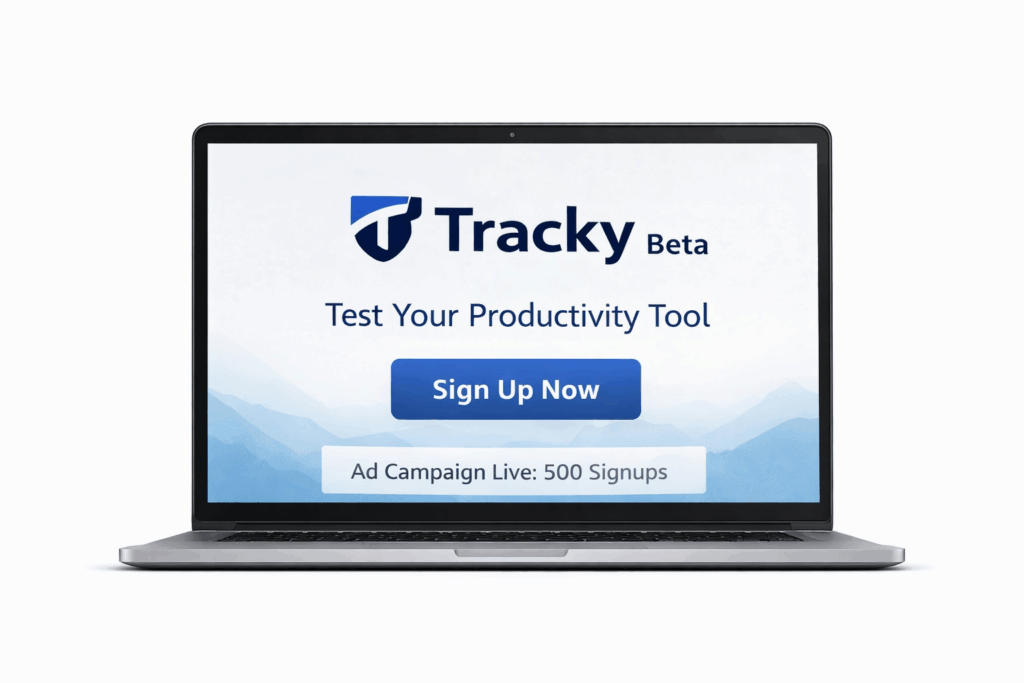
A solo founder launching a beta SaaS tool uses an AI logo to validate demand. The logo isn’t public-facing long-term. It’s there to avoid a blank screen while feedback is collected.
2. Budget-Constrained Side Projects
For side hustles, internal tools, or short-lived campaigns, investing heavily in branding may not be practical. AI logos provide a low-risk way to get started.
Example:
A freelance consultant builds a small scheduling tool for internal use and clients. The project is useful but not meant to become a standalone company. An AI logo gives it a clean look without tying up budget or time.
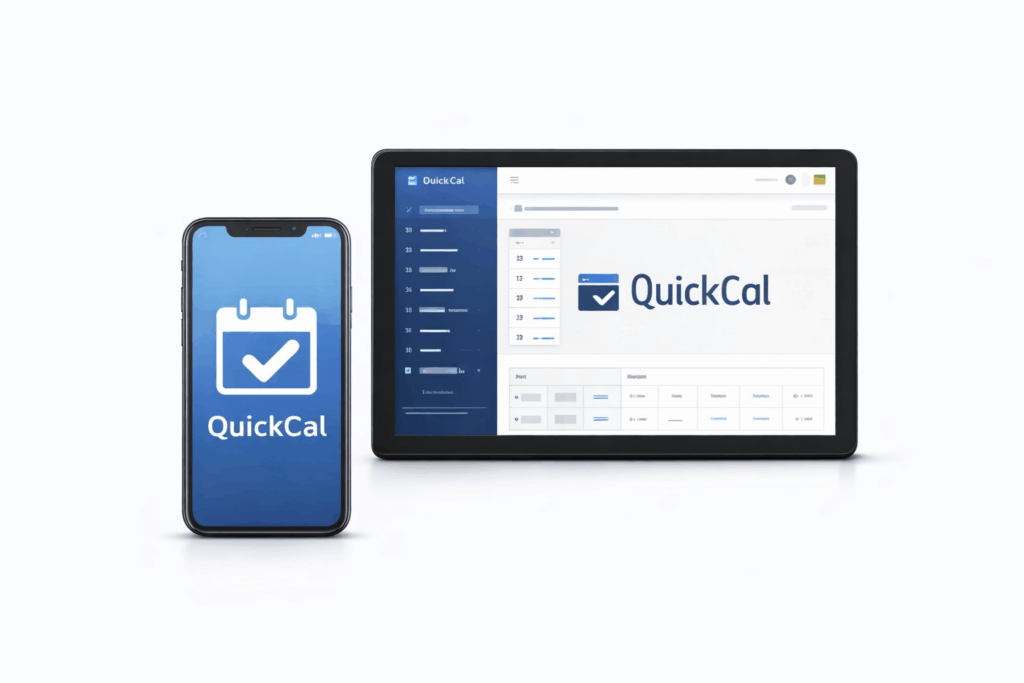
3. Visual Exploration, Not Final Identity
Some designers (myself included) use AI tools as idea generators. Shapes, layouts, or color combinations can spark direction, but they’re refined by human judgment later.
Example:
A startup team uses an AI logo generator to explore colors, layout styles, and symbol ideas. They bring the strongest direction to a designer, who then creates a fully original logo based on that visual direction.
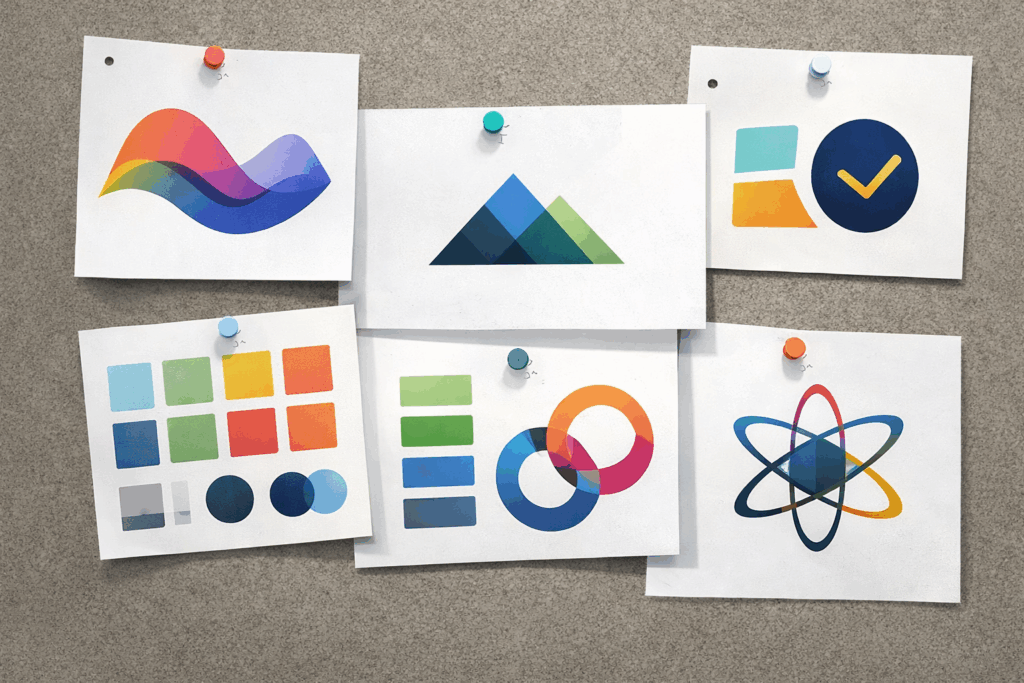
Think of AI logos like stock photos: useful for drafts, dangerous as final assets.
In these cases, AI supports momentum, especially for teams seeking affordable logo design for startups without long-term commitments.
When AI Logos Hurt Brand Growth
This is where most small businesses get burned.
1. When the Logo Becomes Public-Facing Too Early
Once your logo is live on your website, app, or marketing, it starts shaping perception. Generic AI logos often signal “unfinished” or “untrustworthy,” even if your product is solid.
2. When Differentiation Actually Matters
AI tools train on existing design patterns. That means similarity is baked into the output. As your market becomes competitive, looking “like everyone else” quietly erodes brand equity.
3. When Legal or Trademark Protection Is Needed
Many businesses don’t realize this until it’s too late: AI-generated logos can create serious trademark issues due to lack of originality or unclear ownership.
4. When Scaling Is the Goal
Logos don’t exist in isolation. They must work across apps, packaging, ads, social media, and more. AI logos often break when extended into real brand systems, forcing expensive redesigns later.
This is where custom logo design vs templates becomes a business decision, not a design preference.
Note:
Businesses that delay professional branding often pay twice. Once for the AI shortcut, and again to fix it when growth stalls.
Your Brand Deserves More Than an Auto-Generated Logo
AI can give you something that looks fine. We build identities that customers recognize, trust, and remember. If your business is ready to grow, your logo should be too.
The Professional Perspective
AI logo design isn’t a replacement for branding. It’s a shortcut tool. Small businesses succeed when they know when to move fast and when to build deliberately. That’s why experienced designers don’t ask, “Should we use AI?”
They ask, “What stage is the business in, and what’s at risk?”
Used intentionally, AI can support early momentum. Used blindly, it becomes an invisible drag on trust, recognition, and growth.
The Real Limitations of AI Logo Design (Not Just “Creativity”)
AI logo tools do not fail because they lack style. They fail because they lack understanding. AI can produce visuals quickly, but it cannot make the strategic decisions that protect a brand long term.
60% of Fortune 500 companies use combination logos, highlighting how much professional strategy goes into effective marks.
When people talk about the limits of AI logo design, the conversation usually stops at creativity. That misses the real problem. A logo is not an isolated graphic. It is a business decision condensed into a visual form.
AI tools do not understand business context, market pressure, or long-term brand consequences.
I often review AI-generated logos after a business has already launched. The logo looks clean at first glance. The issues only surface later, when the company tries to stand out, build trust, or expand into new markets. At that point, the logo starts working against the business instead of for it.
Here is a practical look at where AI helps and where it consistently breaks down.
AI Logo Design: Practical Pros vs Real-World Cons
| What AI Handles Well | Where AI Falls Short |
| Producing fast visual options | Understanding brand positioning |
| Reducing upfront cost | Creating real differentiation |
| Exploring basic styles | Supporting long-term growth |
| Helping non-designers start | Clarifying ownership and trademarks |
| Consistent formatting | Adapting as the business evolves |
Speed is AI’s strength. Judgment is not.
Why AI Struggles With Brand Strategy
Brand strategy is built on interpretation, not patterns. AI tools generate logos by referencing what already exists. They do not understand why a brand needs to feel premium, conservative, disruptive, or trustworthy.
A human designer begins by asking questions. Who is the customer? What are they cautious about? What visual cues already dominate the industry? What should this brand avoid at all costs?
AI does not ask those questions.
A common scenario I see is this. Two startups in the same industry use AI logo generators. Both end up with abstract symbols, modern fonts, and neutral color palettes. The logos are visually acceptable. Strategically, they are interchangeable. When customers or investors look at them, nothing sticks.
Brand strategy requires intent. AI produces output without intent.
AI Design Limitations in Regulated Industries
In regulated industries, branding mistakes are not cosmetic. They create real risk.
| Industry | Why AI Logos Create Problems |
| Healthcare | Symbols can imply claims or outcomes that are not allowed |
| Financial services | Generic visuals weaken trust and credibility |
| Legal services | Template logos reduce perceived authority |
| Education | Overused icons signal low quality |
| Government and public sector | Accessibility and compliance issues are often ignored |
In these industries, logos must communicate responsibility and restraint. AI tools optimize for appearance, not consequences. They do not understand regulatory sensitivity or reputational exposure.
This is where many businesses are forced into expensive redesigns. Not because the logo looks bad, but because it creates friction with trust, compliance, or perception.
Strategic Takeaway
AI logo design does not fail because it lacks creativity. It fails because branding requires foresight. Logos need to support where a business is going, not just where it starts. Automation cannot evaluate that future. Experienced designers do that by design.
Are AI-Generated Logos Unique, or Just Variations of the Same Idea?
Most AI-generated logos are not truly unique. They are variations built from the same visual ingredients, which is why so many of them feel familiar even when you cannot explain why.
This is one of the most common questions I hear from founders. They look at an AI logo and say, “It looks fine, so why does it feel off?” The answer is usually not about quality. It is about sameness.
56% of Gen Z have purchased a product because of an interesting logo, highlighting the importance of distinct visual identity.
AI logo tools are designed to recombine what already exists. That makes them efficient, but it also puts a ceiling on originality. When dozens of businesses in the same industry use the same generators, the visual overlap becomes unavoidable.
This is where the difference between custom logo design vs templates stops being theoretical and starts showing up in real brand outcomes.
How AI Logo Generators Actually Work
AI logo generators do not invent design ideas. They assemble them.
At a practical level, these tools rely on large datasets of existing logos, fonts, icons, and color combinations. When you enter your industry, keywords, and style preferences, the system predicts which visual patterns are most likely to fit that input.
Here is what that looks like in the real world.
If you run a tech startup, the AI tends to suggest geometric symbols, gradients, and modern sans serif fonts. If you run a wellness brand, you see leaves, circles, soft curves, and muted greens. These choices are not wrong, but they are predictable.
Because the system optimizes for familiarity, not differentiation, two businesses with similar inputs often receive visually similar results. That is why AI logos rarely feel bad. They just rarely feel memorable.
A human designer approaches this differently. Instead of asking what looks appropriate for the category, they ask what will stand apart within it.
How to Customize an AI Logo to Avoid Generic Results
If you decide to use an AI logo tool, the worst mistake you can make is accepting the first output. That is how brands end up looking interchangeable.
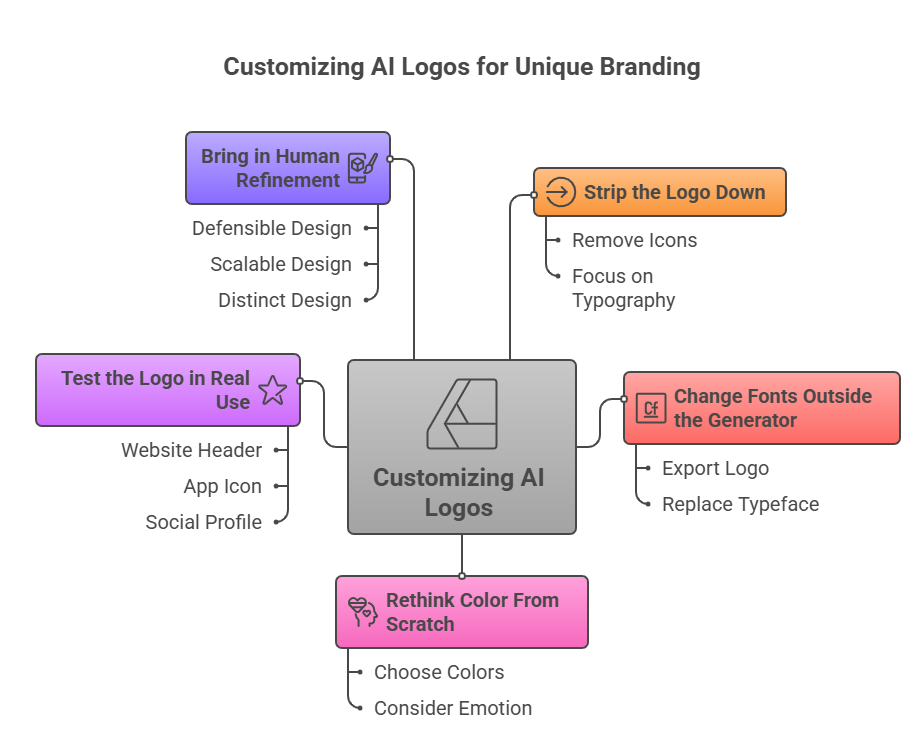
Here are practical ways to reduce that risk.
1. Strip the Logo Down First
Remove icons and symbols before you evaluate anything. Focus on typography and structure. Many AI logos hide their sameness behind decorative icons.
2. Change Fonts Outside the Generator
Most AI tools recycle a limited font library. Export the logo and replace the typeface manually. Typography alone can dramatically change brand perception.
3. Rethink Color From Scratch
Default color palettes are one of the biggest sources of repetition. Choose colors based on contrast and emotion, not industry norms.
4. Test the Logo in Real Use
Place the logo on a website header, app icon, and social profile. Generic logos reveal themselves quickly when applied in real contexts.
5. Bring in Human Refinement
This is where professional logo design services add value. A designer can take an AI starting point and rebuild it into something defensible, scalable, and distinct.
Think of AI logos as rough sketches. They can point you in a direction, but they should not define your destination.
Uniqueness in branding does not come from generating more options. It comes from making intentional choices. That is something automation still cannot do on its own.
Are AI Logos Legal? Trademark Risks Every Business Should Know
Not always. Many AI-generated logos cannot be protected the way most businesses expect, which makes them risky for any brand that plans to grow.
10–20% of marketing budgets are spent on branding and rebranding, which often includes costs to fix legal or confusion issues with logos.
This is the part almost no one thinks about when clicking “download” on an AI logo. A logo is not just something you like visually. It is something you may need to defend legally when your business becomes visible. And that is where AI logos can quietly put you in a weak position.
I have seen this happen more than once. A company launches with an AI-generated logo, gains traction, and then discovers that it cannot secure trademark protection. Or worse, another business claims something similar already exists. At that point, the logo that once felt like a bargain becomes a liability.
Here is what every business should understand before relying on an AI-generated mark.
Legal reality checklist
- Trademark law requires originality, not just aesthetics
- AI outputs may be too similar to existing logos
- Ownership of AI-generated work is not always clear
- Some jurisdictions require human authorship
- Redesigns cost far more after a brand gains recognition
These are not edge cases. They are common outcomes when branding starts with automation instead of intention.
Can AI Logos Be Trademarked?
Sometimes yes, often no. A trademark is granted when a logo is considered distinctive and owned by a specific business. The problem with AI logos is that they are produced from systems trained on massive collections of existing designs. That increases the chance of overlap with something already in use.
Another issue is authorship. In many regions, copyright and trademark protection depends on human creative input. If a logo is generated entirely by software, proving ownership becomes harder.
In practice, this means an AI logo might look new but still fail a trademark search. When that happens, businesses are forced to rebrand after they have already invested in marketing, packaging, and customer recognition.
That is why professional designers do not just create logos. They design marks that can survive legal review.
How to Document Human Contribution in AI Logos
If you choose to use AI as part of your process, the safest path is not to rely on it alone. You need to show that a human made meaningful creative decisions.
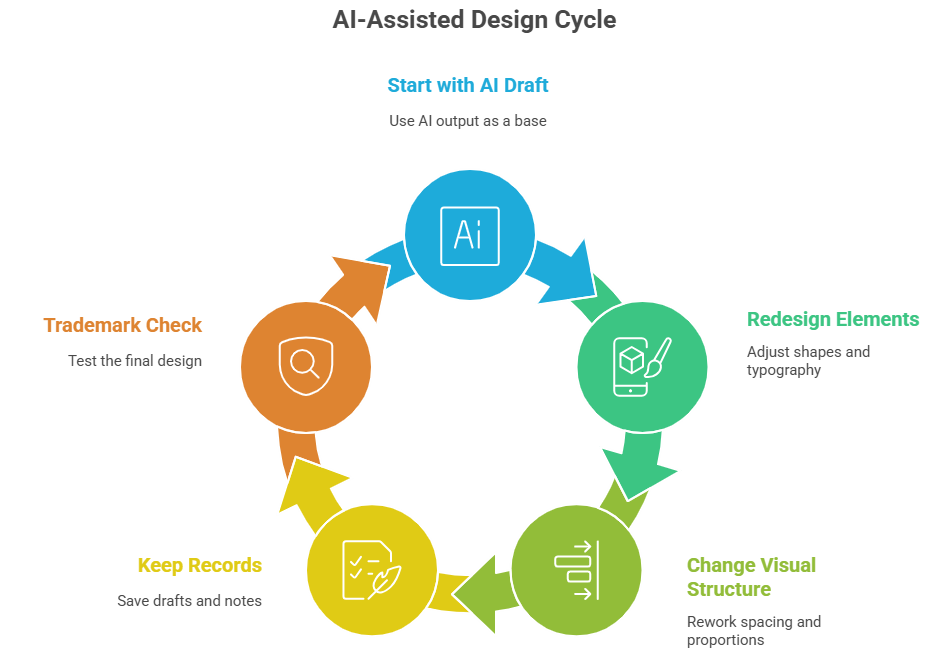
Here is how experienced teams do it.
1. Start with AI as a rough draft. Use the AI output as a base, not a final file.
2. Redraw or redesign key elements. Adjust shapes, typography, and layout so the final mark is clearly altered by a human hand.
3. Change the visual structure. Rework spacing, alignment, and proportions. This is where originality begins.
4. Keep records. Save drafts, design files, and notes that show how the logo evolved. This creates a paper trail of human authorship.
5. Run a trademark check on the final design. Always test the finished logo, not the AI version, before committing to it.
This approach does not eliminate all risk, but it dramatically improves your ability to claim ownership and protect your brand later.
The Professional Reality
AI makes it easy to get a logo. It does not make it easy to keep one.
When a business grows, its logo becomes an asset. Assets need protection. The brands that struggle are not the ones that chose AI. They are the ones that never thought about what happens after.
AI vs Human Logo Design: When to Hire a Professional Designer
AI is useful when nothing is at stake. A designer becomes essential when your brand starts to matter. If your business plans to grow, compete, or be taken seriously, human-led logo design is no longer optional.
Most founders do not wake up planning to hire a designer. They do it when something breaks. Customer trust drops. Marketing feels harder. Investors ask why the brand looks generic. That moment is not about taste. It is about credibility.
This is where professional logo design services stop being a nice-to-have and become a business tool.
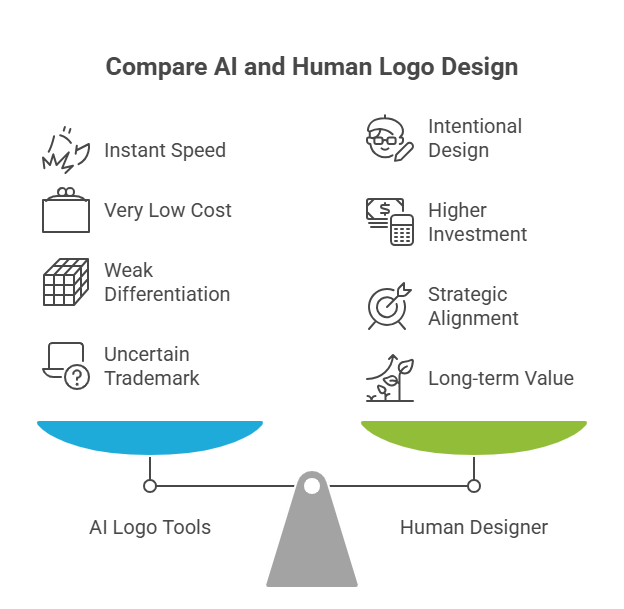
AI gets you something to look at. A designer gives you something to build on.
Cost vs Value: Cheap Logos vs Brand Equity
A logo that costs very little often ends up being the most expensive.
Here is how this usually plays out.
A founder picks a twenty-dollar AI logo. It looks fine. The business grows. They print it on packaging, build a website, and start advertising. Six months later, they realize the brand feels forgettable. Or they face a trademark issue. Now they have to change everything.
The cost is not just a new logo. It is:
- redesigning the website
- reprinting materials
- updating social profiles
- reintroducing the brand to customers
That is why brand equity matters more than sticker price.
ROI snapshot
- Low-cost logo: saves money now, costs more later
- Strategic logo: costs more now, saves and earns money over time
This is especially important for teams looking for affordable logo design for startups without sabotaging future growth.
The Hybrid Model: AI Plus Human Direction
This is where smart businesses are heading.
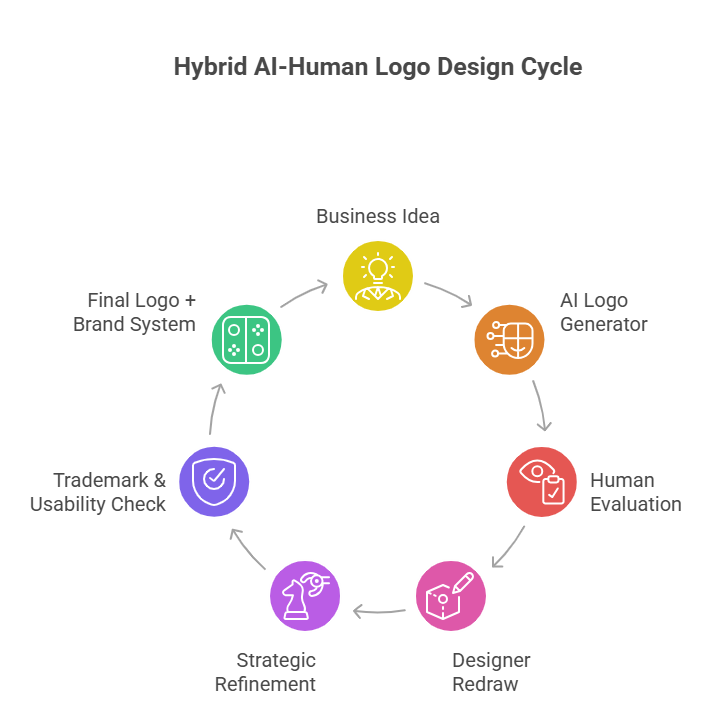
AI can help generate ideas quickly. A human designer decides what is worth keeping.
Here is what that workflow looks like in practice.
| Step | Who Does It | What Happens |
| Concept exploration | AI | Generates multiple visual directions |
| Selection | Human | Chooses what fits the brand |
| Redesign | Human | Rebuilds the logo with originality |
| Refinement | Human | Adjusts typography, spacing, balance |
| Brand system | Human | Extends the logo across all uses |
This model keeps speed without sacrificing quality. It is why modern small business branding packages often blend AI tools with professional design oversight.
Pro Tip
AI can help you start. A designer helps you last.
The moment your logo needs to earn trust, survive legal scrutiny, or support growth, automation alone is not enough. The smartest brands use tools to move faster and people to move smarter.
Wrapping it Up
AI logo design is not the enemy. Blind reliance on it is.
If you are testing an idea, AI is a practical starting point. If you are building a real business, the choice between custom logo design vs templates becomes a strategic one.
The smartest brands use AI for speed and professionals for direction. That combination gives you momentum without sacrificing identity.
Turn Your AI Logo Into a Brand You Can Own
Already started with AI? We refine, redesign, and protect your logo so it becomes distinctive, scalable, and legally defensible as your business grows.